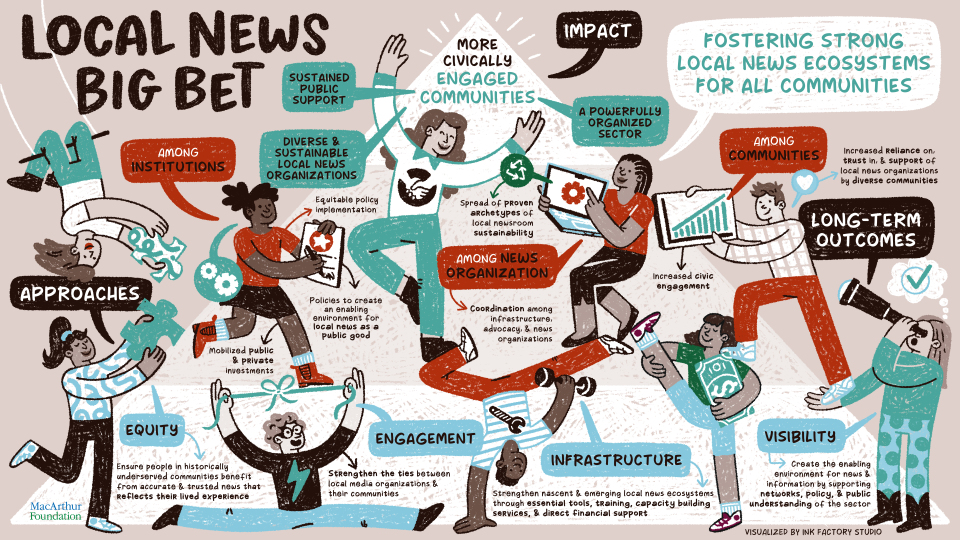



The MacArthur Foundation is making a big bet on local news, catalyzing hundreds of millions of dollars to support the sector through its own giving, as well as through its role spearheading the larger funder movement known as Press Forward. But with an ambitious goal like this, one question looms large: where do you start?

A Data-Driven Roadmap for Reinvestment in Appalachia
For Press Forward (PF) Central Appalachia, the challenge is clear: bringing new life to the news and information ecosystem across a vast, primarily rural region. To convince national funders to invest in an area historically overlooked, the team focused on building a powerful, data-driven case for support.
They worked to answer a critical question: How does the decline of local news impact the well-being of a community, and what is the real-world return on investing in it? This is where their comprehensive research, “The State of the News Business in Central Appalachia – Models for Reinvestement” came into play, with the Civic Information Index (CII) serving as a foundational analytical tool. We sat down with the Press Forward Central Appalachia research team to understand their process.
The Advantage of Readily Available Data
"Not having to organize this data ourselves has allowed us to spend resources on supplementing and analyzing the data, rather than finding and housing it."
For a research project of this scale, the first hurdle is gathering credible, comprehensive data. The PF Central Appalachia team found that the CII provided an immediate and practical advantage by solving this problem from the outset.
“Not having to organize this data ourselves has allowed us to spend resources on supplementing and analyzing the data, rather than finding and housing it. This saves us a lot of time and would allow us to shift our impact research and tools development timeline forward,” said Eli Flournoy, coordinator for the Press Forward Central Appalachia Chapter. With this foundation in place, the team was able to move directly to the crucial work of analysis and storytelling, saving them time and resources.
From National Map to Regional Story
The research team integrated the Index as a core part of their work to analyze the region’s challenges. They began by using the Index’s national map to provide a clear, visual starting point, which highlighted Central Appalachia as a concentrated area of low civic health.

From there, the team used the raw data from the Index to create their own analysis, quantifying the disparity. This confirmed that rural Appalachian counties scored significantly lower than the rest of the U.S. across every pillar (from civic participation to health and opportunity). The Index provided the hard numbers to validate what many in the region already knew.
The Key Finding: Connecting News to Civic Health
The most powerful insight came when the researchers combined the Index’s civic health scores with data on the number of news outlets in each county. This data aggregation allowed them to demonstrate the clear, direct, and stunning correlation.
Their analysis found that for every additional news outlet in a Central Appalachian county (for counties with five or fewer outlets), the average civic health score is 7 points higher. This single data point became the cornerstone of their argument. It transformed a long-held belief into a quantifiable reality, allowing them to state with confidence that “the largest social impact from increasing news access is obtained by funding news in the communities with the fewest outlets and journalists”, the very communities that define rural Appalachia.
Why It Matters: A Data-Driven Roadmap for the Future
By leveraging the Civic Information Index, PF Appalachia created more than just a report; they built a roadmap for investment. The Index helped them frame the conversation from one of need to one of strategic opportunity.
“The data show that there is a concurrent rise in civic health with increasing levels of news and information access, and this relationship is most notable in communities with the lowest levels of civic health and news coverage, like those in Central Appalachia.”
The data provided the evidence needed to guide the funding decisions of their Rural News Fund and to make a compelling, numbers-backed case for national philanthropy and investment in the region. “The data show that there is a concurrent rise in civic health with increasing levels of news and information access, and this relationship is most notable in communities with the lowest levels of civic health and news coverage, like those in Central Appalachia,” said Luke Boutwell, co-author of the Report.
The report underscores the Civic Information Index as a practical tool for the region and recommends that local organizations and newsrooms use it to identify themselves as “high-need areas” in grant applications. “The core purpose of news media is to strengthen civic health, with civic health defined as the degree to which citizens participate in their communities,” says the report. By demonstrating the clear connection between strong local news and community well-being, the research shows that investing in journalism isn’t just about saving a newspaper or a news outlet, it’s about reinforcing the civic infrastructure of entire regions.
We are deeply grateful to Press Forward Central Appalachia for generously sharing their story.
Related Posts